


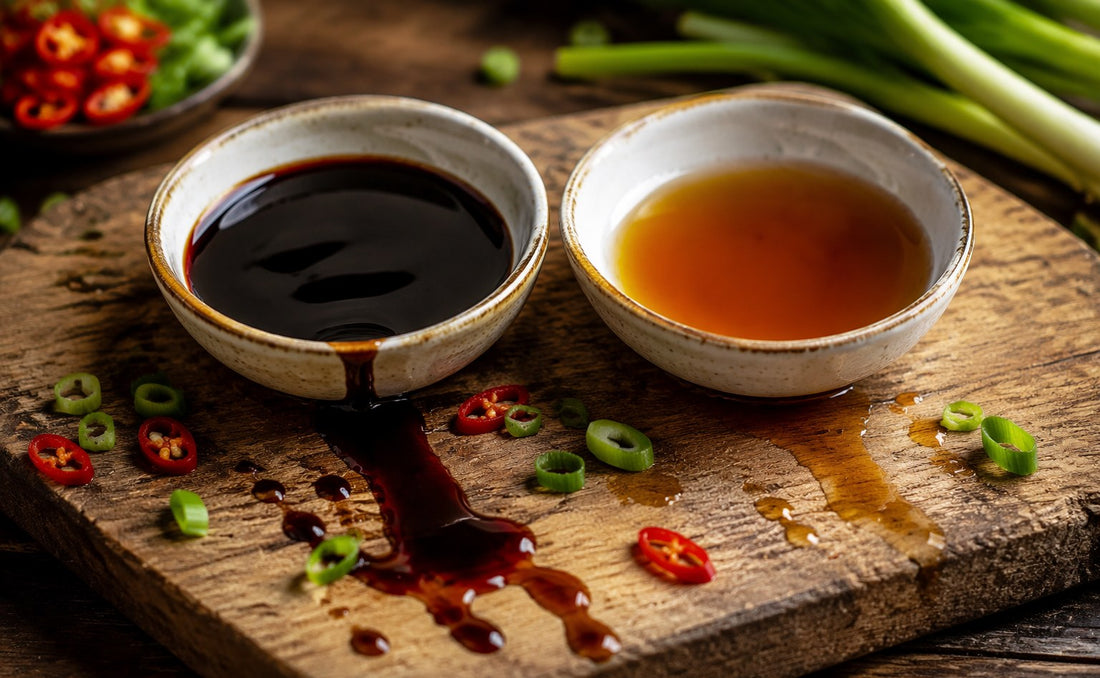
The short version: light soy sauce is thin, salty and the one you reach for most — it seasons stir-fries, dressings and dipping sauces. Dark soy sauce is thicker, less salty and slightly sweet, used in smaller amounts mainly for colour, giving braises and noodles that glossy mahogany look. They are not interchangeable.
Here is how to use each properly.
Light soy sauce — your everyday workhorse
This is the default "soy sauce" in most Chinese recipes. Thin, light brown, and forward with salt and savoury flavour. It is the first pressing of the fermented soybean mash, which is why it is lighter in body and higher in salt.
Use it to season stir-fries, marinades, soups and dressings, and as a dipping sauce at the table. If a recipe simply says "soy sauce", it almost always means light. Our Lee Kum Kee Premium Light Soy Sauce is a reliable, naturally brewed standard.
Dark soy sauce — for colour and depth
Dark soy is aged longer and usually has a touch of molasses or caramel added. It is thicker, darker and less salty, with a gentle sweetness and a slightly syrupy body.
You use it sparingly — often just a teaspoon — to give dishes a deep brown colour and rounded depth. Think red-braised pork, char siu, and hong shao dishes where the colour matters as much as the taste. Reach for Lee Kum Kee Premium Dark Soy Sauce.
Side by side
| Property | Light soy sauce | Dark soy sauce |
|---|---|---|
| Colour | Light reddish brown, translucent | Near black, opaque |
| Texture | Thin and watery | Thicker, slightly syrupy |
| Saltiness | High — this is your seasoning | Lower |
| Sweetness | Barely any | Noticeable, from added molasses or caramel |
| Typical quantity | Tablespoons | Teaspoons |
| Main job | Flavour and salt | Colour and depth |
| Chinese name | 生抽 (sheng chou) | 老抽 (lao chou) |
A quick rule of thumb
- Flavour and seasoning? Light soy.
- Colour and a hint of sweetness? Dark soy.
- Most home recipes use both — light for taste, a small amount of dark for the look.
A typical stir-fry sauce might use two tablespoons of light soy and one teaspoon of dark. That ratio is a good starting point whenever a recipe is vague.
Common mistakes
Using dark soy as your main seasoning. The dish will look beautifully glossy and taste bland, because dark soy carries far less salt. This is the single most common mistake.
Using light soy for colour. You would need so much that the dish becomes inedibly salty long before it darkens. Reach for the dark bottle instead.
Adding soy sauce too early in a stir-fry. Poured straight onto ingredients it stews them. Pour it down the hot side of the wok so it sizzles and caramelises on the way in.
Assuming all brands are equal. Naturally brewed soy sauce tastes markedly better than chemically hydrolysed versions. Check the label for "naturally brewed".
What about the other soy sauces?
Sweet soy sauce is thick, syrupy and noticeably sweet — a different ingredient again, and lovely in South East Asian dishes. Indonesian kecap manis is the best-known style. Our Healthy Boy Sweet Soy Sauce is a Thai version and a good example if a recipe calls for one.
Seasoned or premium soy has added flavourings such as mushroom or shrimp extract, and is used as a finishing sauce, particularly over steamed fish.
Japanese shoyu is brewed with roughly equal parts soybean and wheat, making it slightly sweeter and less sharply salty than Chinese light soy. Tamari is the wheat-free Japanese version and the one to buy if you need gluten-free.
Lee Kum Kee Premium Light Soy Sauce 500ml
The everyday bottle — naturally brewed, clean and salty. If you only buy one soy sauce, buy this one.
View product →Lee Kum Kee Premium Dark Soy Sauce 500ml
The colour bottle. A teaspoon is usually all you need, so it lasts a very long time.
View product →Tuk Tuk tip: keep both a light and a dark soy in the cupboard. Most Chinese dishes use light for seasoning and a small splash of dark for colour — once you have both, you will cook far more confidently. Browse the full soy sauce range.
How to store soy sauce
Unopened, soy sauce keeps for years in a cupboard. Once opened it is best kept in the fridge, where it holds its flavour for around six months — it will not spoil at room temperature, but it darkens and dulls faster. Always keep the cap on; oxygen is what flattens the flavour.
Soy sauce FAQs
Can I use dark soy sauce instead of light soy sauce?
Not as a straight swap. Dark soy is less salty and used mainly for colour, so a dish made only with dark soy will look right but taste under-seasoned. Use light soy for flavour and dark soy for colour.
Is dark soy sauce saltier than light soy sauce?
No — light soy sauce is saltier. Dark soy is thicker, slightly sweet and less salty, which is exactly why it is used in much smaller amounts.
What is the difference between dark soy and sweet soy sauce?
Dark soy is used in small amounts for colour and depth. Sweet soy sauce is thick, syrupy and noticeably sweet, used as a flavouring in its own right rather than as a seasoning.
Which soy sauce should I buy first?
Light soy sauce — it is the everyday all-rounder. Add a dark soy next for colour in braises and noodles.
Is soy sauce gluten free?
Most Chinese and Japanese soy sauces are brewed with wheat and are not gluten free. Tamari is the wheat-free Japanese alternative and works as a direct substitute for light soy.