


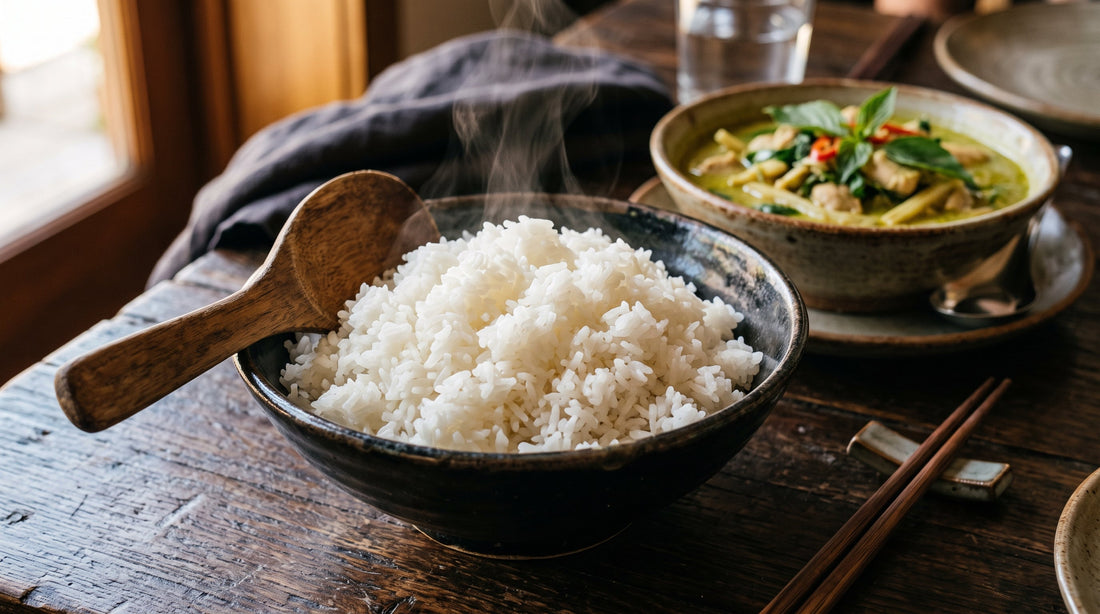
Jasmine rice is the everyday rice of Thailand and much of South East Asia — soft, slightly sticky, and fragrant enough that you can smell it from the next room while it cooks. If your homemade curries and stir-fries never quite taste like the restaurant version, the rice is often the missing piece. Here is what makes jasmine rice different, how to cook it perfectly, and what to serve it with.
What is jasmine rice?
Jasmine rice is a long-grain rice grown mainly in Thailand, Cambodia, Laos and Vietnam. In Thai it is called khao hom mali — "fragrant jasmine rice" — after its distinctive floral aroma, which comes from a natural compound (2-acetyl-1-pyrroline, if you like the science) also found in pandan leaves.
The best jasmine rice is Thai hom mali, a protected grade that guarantees the rice is the genuine fragrant variety grown in Thailand. It is the benchmark the whole category is judged by, and the words to look for on the bag.
Jasmine rice vs basmati — what's the difference?
The two most common fragrant rices in UK kitchens, and they are not interchangeable:
- Texture: jasmine cooks up soft and slightly clingy — grains hold together just enough to eat with a fork or spoon alongside saucy dishes. Basmati cooks drier and fluffier, with separate, firm grains.
- Aroma: jasmine smells floral and faintly sweet, like pandan. Basmati is nuttier and earthier.
- Best with: jasmine suits Thai, Vietnamese, Chinese and other South East Asian dishes. Basmati is the rice for Indian and Middle Eastern cooking.
Rule of thumb: if the dish comes from South East Asia, cook jasmine. Your green curry will thank you.
How to cook jasmine rice perfectly
The single biggest mistake is using too much water. Jasmine rice needs less water than most people think — that is what keeps it fragrant and fluffy rather than soggy.
- Rinse once or twice in cold water until it runs mostly clear. This removes surface starch so the grains stay distinct. Don't over-rinse — you are washing, not polishing.
- Use the right ratio: 1 cup of rice to 1¼ cups of water in a rice cooker, or 1:1½ on the hob. (Fresh-crop rice, sold in the months after harvest, needs even less — closer to 1:1.)
- Hob method: bring to the boil, stir once, cover tightly, and cook on the lowest heat for 12 minutes. Do not lift the lid.
- Rest for 10 minutes off the heat, lid still on. This finishes the cooking with steam and is the step everyone skips.
- Fluff with a fork or rice paddle and serve.
What to serve with jasmine rice
- Thai curries — green, red, massaman and panang are all built to be eaten over jasmine rice.
- Stir-fries — pad krapow (holy basil stir-fry) over jasmine rice with a fried egg is Thailand's favourite fast lunch.
- Chinese dishes — steamed jasmine rice alongside sweet and sour, char siu or egg fried rice (day-old jasmine rice is the best base for fried rice, in fact).
- Vietnamese and Malaysian food — from broken rice dishes to nasi lemak's coconut rice, which starts with jasmine rice cooked in coconut milk.
How to store rice — and which size to buy
Uncooked jasmine rice keeps for a year or more in a cool, dry cupboard in an airtight container. Cooked rice should be cooled quickly, refrigerated within an hour and eaten within a day — or frozen, which it handles well.
On pack size: rice is dramatically better value in big bags. If rice is on the table more than twice a week, the 10kg sack pays for itself quickly. If you cook it occasionally, a 2kg bag keeps the rice fresh — aroma fades slowly once the bag is open.
Our jasmine rice range

Royal Umbrella Thai Jasmine Rice 2kg
Genuine Thai hom mali in a kitchen-cupboard-friendly size — the one to start with.
View product →
Royal Umbrella Thai Jasmine Rice 10kg
The family sack — the best value per bowl for households where rice is a daily staple.
View product →Browse the full rice collection for glutinous rice, sushi rice, rice blends and big-sack value sizes.
Jasmine rice FAQs
Is jasmine rice the same as sticky rice?
No. Jasmine rice is slightly clingy but it is not "sticky rice". True sticky rice is glutinous rice — a different grain entirely, used for dishes like mango sticky rice and cooked by steaming rather than boiling.
Is jasmine rice gluten free?
Yes. Like all plain rice, jasmine rice is naturally gluten free. "Glutinous" in rice names refers to stickiness, not gluten.
Why is my jasmine rice mushy?
Almost always too much water, or lifting the lid during cooking. Cut the water to the ratios above, keep the lid on, and rest the rice for 10 minutes before fluffing.
Can I use jasmine rice for fried rice?
It is one of the best choices. Cook it a day ahead, refrigerate uncovered so it dries out a little, and it fries into separate, lightly chewy grains instead of clumping.
What does "new crop" mean on a rice bag?
Rice from the most recent harvest. New-crop jasmine rice is more fragrant and needs slightly less water. Rice enthusiasts actively look for it, the way coffee drinkers look for fresh roasts.